
I have two habits that I am passionate about—reading and bike riding. I am on pace to read 95 books on various books from food to literature to politics to religion to science to many other topics in 2024. We get out about 5 days a week to bike the Swamp Rabbit Trail—roughly 13-14 miles round trip. Below are short reviews of seven books on food that I found particularly intriguing that you might want to consider as holiday gifts for foodies on your list.
Zero Waste Cooking for Dummies by Rosanne Rust is a delightful book that I highly recommend. Be forewarned, the book is not really about eliminating waste in the home kitchen. Rather, it is about decreasing that waste. Also, if you are not familiar with Dummies books, don’t be put off by the title. Dummies books tend to be written by experts in the field who write in easy-to-understand language and provide practical suggestions. I suspect all but the most-experienced home cooks could pick up some useful ideas from the author. My biggest problem with waste during cooking is accumulation of exotic ingredients when I try out a new recipe. My pantry and refrigerator have become permanent homes for these once-used ingredients. Two suggestions that I found particularly useful in Rust’s book were to mix and match leftovers for new culinary experiences and designate once-a-week meals to clean out accumulation of items either in the refrigerator or pantry. I also highlighted recipes I wanted to try to expand my kitchen repertoire. That project came to a screeching halt when I prepared and ate the Texas Caviar, experiencing unpleasant gaseous repercussions! I am ready to start over to explore intriguing recipes from the book again.
Sweetness and Power: The Place of Sugar in Modern History by Sidney W. Mintz. The book is a struggle through the first 73 pages in the discussion of anthropological and production aspects of sugar. The author rewards the patient reader in the third chapter with a history of sugar consumption with particular reference to England. Throughout history sugar has served as a condiment, a food, a medicine, a preservative, a spice, a sweetener, and a thickener. Sugar started out as a status symbol which gradually became the opiate of the masses as the colonial system exploited slave labor and trade agreements to lower the price. It wasn’t until homemakers incorporated it into baked goods and confections followed by its use in processed foods that daily consumption increased dramatically! Worse yet, sugar increased demand for other evils such as chocolate, coffee, and tea! The last chapter disappoints again reverting to a screed condemning modern society and its dependence on foods made by novel processes and ingredients.
Mise: The Future of Food, Rethinking Reality by Mike Lee is a vast undertaking in the quest for a healthier, more sustainable food supply. In French mise en place refers to “a culinary process where ingredients are prepared and organized (as in a restaurant kitchen) before cooking.” The book develops scenarios of food in the future based on “five factors that shape the future of food”—societal, technological, economic, environmental, and political. Four scenarios were developed—regenerative dystopia (2033), green revolution redux (2042), the nutrition stack (2052), and a new superpower (2067). Each factor was graded on a 1-5 scale for each scenario. With such a great start, what could possibly go wrong? Unfortunately, I found the scales to be unidimensional. The only scale dealing directly with food, societal, rated food from a score of 1=ultraprocessed diets to 5=better for you diets. Is that as good as we can do? Are palatability, cultural values, socal settings, nutritional quality, health, and safety not important? I am not a big fan of algorithms, but such factors might be appropriate in these projections.
Then there are four books I have reviewed earlier in the year—one on an alternative, sustainable source of protein and three in a series on the evolution of the supply chain, wholesaling, and the development of the modern supermarket.
Insects as Sustainable Food Ingredients edited by Aaron Dossey, Juan Morales-Ramos, and M. Guadalupe Rojas describes a sustainable alternative to meat as a source of nutrients with a special emphasis on protein. It is a very thorough technical discussion as to how these ingredients could be incorporated into formulated food products. When will we give up our dependence on meat? How many climate disasters will it take to get us to change our ways? American reluctance to incorporate insect ingredients or plant-based products into alternative sources of protein indicate that we have not bought into the global climate-change threat. The future is not looking bright as recent layoffs at a large cricket farm and processing plant suggest that we are not ready to adapt to a more sustainable lifestyle.
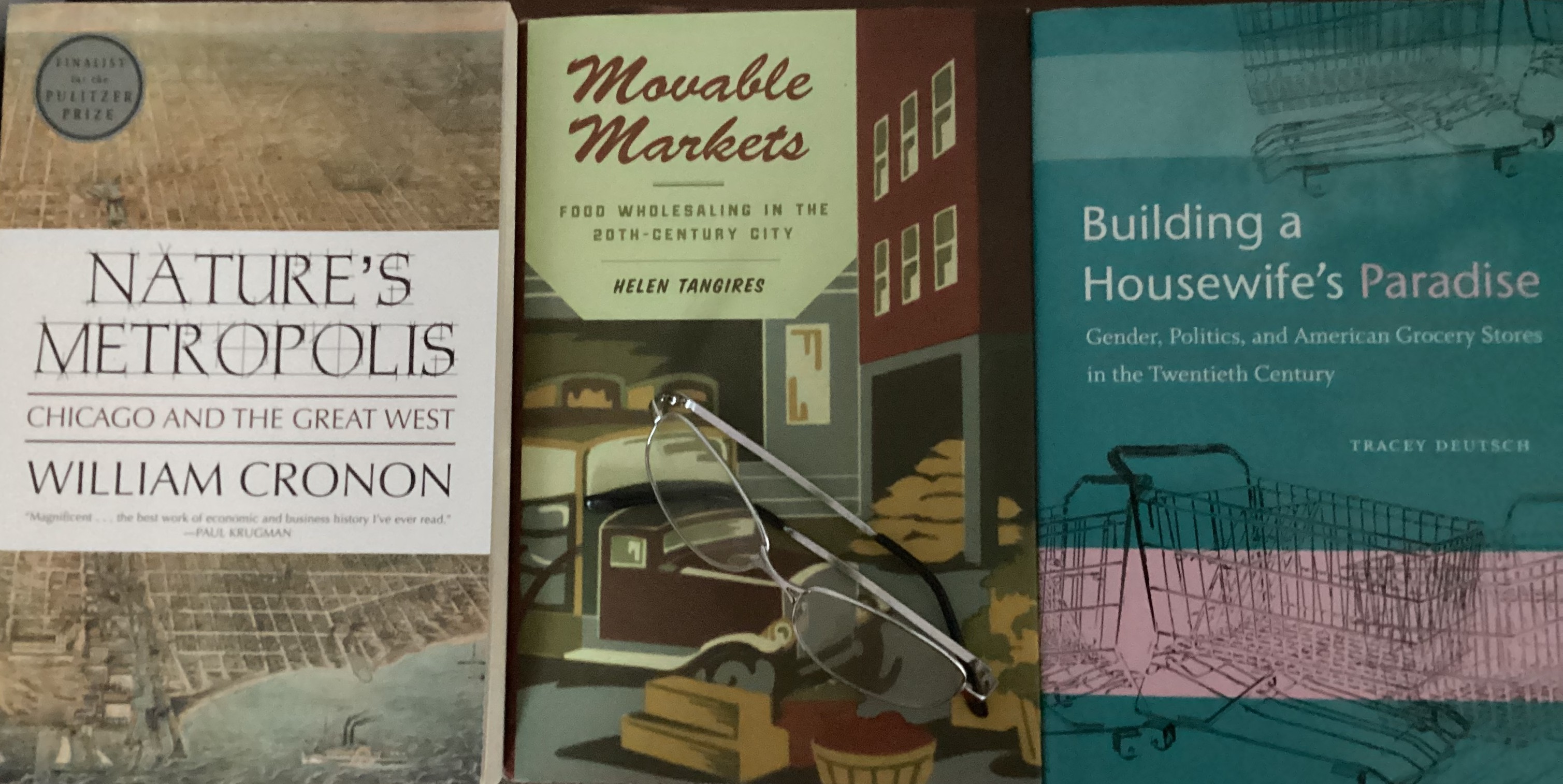
Nature’s Metropolis: Chicago and the Great West by William Canon is the first of my supply-chain-review trilogy. Chicago became a hub for cereal grains, lumber, and meat. To establish itself as the focal point of distribution, Chicago became dependent on farms to the Great West. Getting these items to the city was the problem. Water transport was inefficient, automobiles had not been invented yet, and roads were not passable for much of the year. That’s where railroads came in and the early vestiges of the modern supply chain. By now the farms became dependent on the city for sales. The banks stepped in to make farm-to-city transactions possible. Progress was charted by the development of new industries and tracking modernization through bankruptcies of small businesses. Readers are treated to a fascinating view of where we were as a country, how we developed, and the primitive beginnings of today’s food distribution system.
Moveable Markets: Food Wholesaling in the Twentieth Century City by Helen Tangires tackles wholesale distribution of food occupied by the modern-day boogie man—the middleman! Our idyllic view of how the “food system” should operate involves buying food directly from the farmer or at the farmers market without anyone intervening in between. But that is not the way it works for most food purchases in America today. Today’s supermarket is only one stop in a long supply chain between grower and merchant. And is the vendor at the farmers market actually the farmer or even a paid employee of the farmer? Or did the farmer contract that service out to a vendor operation? Tangires brings us into the wholesale market of whole foods providing a different view of the middleman and his or her important function in providing the foods we want to buy and eat.
Building a Housewife’s Paradise: Gender, Politics, and American Grocery Stores in the Twentieth Century by Tracey Deutsch picks right up in Chicago where Nature’s Metropolis left off. She helps us understand the modern food supply chain’s primary destination is today’s supermarket. The original supermarkets were food warehouses with exposed wooden beams and studs, sort of a primitive Costco or Sam’s Warehouse. At first, state governments fought them coming into local markets as cash register receipts flowed to other states. Supermarkets were better able to keep up with retail-sale record providing more accurate tax collections and a nice flow of revenue to state government. Women were the primary target for marketing campaigns by supermarkets, while male regulators failed to understand the relationship between the chains and their customers. Supermarkets morphed into many configurations. A current modern supermarket consists of a bakery, a butcher shop, deli, a pharmacy, and multiple departments. Is the grocery store where you shop a modern supermarket? Mine is.
Take-home lessons. There are many wonderful books out there on the food we eat, and not all of them preach at us on what we should eat and what foods we should avoid. Food is about so much more than nutrition and health. It is about history, and culture, and social interaction. The books I covered in this post incorporate
- how we can waste less food when we cook at home;
- the domination of sugar in our diets and the terrible consequences for those who harvest it for our eating pleasure;
- the future of food from the perspectives of health, sustainability, economics, technology, and politics;
- the potential for a more sustainable and healthy diet when considering alternate protein ingredients; and
- the development and integration of resources from supply chain, to wholesaling, to supermarkets.
So many books on food and so little time to keep up!
Coming soon: The food year in review

 In Defense of Processed Food
One thought on “Waste reduction, the power of sugar, cooking in place, edible insects, and the supply-chain trilogy–Food books I read in 2024”