
In my last post I revealed some hints as to how the supply chain originated in America and how it evolved as viewed from the city of Chicago. The city’s emergence in the dawn of Twentieth Century produced major changes in the interaction of food marketing with consumers. These changes are highlighted in Building a Housewife’s Paradise: Gender, Politics, and American Grocery Stores in the Twentieth Century by Tracey Deutsch. The setting for this transition from open markets to supermarkets is also Chicago. My last post was on the origin of the supply chain in the 1800s. This week we pick up the story in the early 1900s.
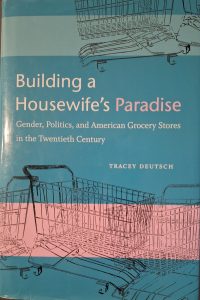
A major premise of Deutsch’s book holds that grocers design their stores to appeal to women—the prime shoppers of food. Out of a culture of buying food for families from open markets came peddlers and their carts and the independent neighborhood markets, including corner stores. Chain grocery stores rose from 1914-1933 as they overtook smaller, locally owned stores. These chain stores emphasized low prices appealing to women’s independence and their autonomy in the kitchen. Note that this was the era when 18th Amendment (Women’s Suffrage) passed. At the same time, there was great inflation in grocery prices before, during, and after WWI. Blame for the high prices was placed directly on the middlemen (wholesalers and grocers). Much of this blame fell on Greeks and Jews as they were overrepresented in the trade.
Chain grocers benefitted from economies of scale which lowered prices, displayed trustworthy foods in a clean environment, and promoted women’s freedom to choose. Chain stores undersold neighborhood markets by about 10%. Policies by the chains set firm prices for each item thus eliminating haggling with store personnel. Buying on credit as practiced by neighborhood stores was also not an option in the chain stores. As the chains consolidated, they standardized distribution featuring streamlined supply chains. It was here that food marketing was redefined as it bled over into mass marketing of consumer goods. At first, chain stores were about lower prices but then they became more about service. They targeted the middle-and-upper-class women so much that the terms consumer and women became synonymous.
Regulating grocery stores was primarily a municipal function until the 1930s. At first, the Illinois state legislature tended to be anti-chain as profits were sucked out of both the city and the state. Sales taxes introduced during the 30s led to greater oversight by the state. Chain grocery stores were easier to regulate than independent stores, which did not keep good financial records. Locally owned neighborhood stores tended to have fewer choices and higher prices. Independent grocers did not work as well with the relief agencies during the Depression as the chain stores. Ration boxes from the federal government failed to provide individual choices or allow for cultural preferences. Governmental help for impoverished families came as cash assistance allowing women to shop around for the best bargains.
Consumer activism didn’t start with Ralph Nader. A push “for consumer education, the testing and grading of consumer goods, and an end to misleading advertising” was led much earlier by both women and men of Chicago’s professional class. They organized protests against high prices, labor practices, and unfair weights and measures. Cooperatives were established to compete with the chain grocery stores. They became a small but growing part of food distribution with the more successful co-ops taking on chain-store practices. The movement supported more liberal causes such as gender and racial equity.
Supermarkets did not emerge until the 30s, and they didn’t look like the supermarkets of today! Very large independent entities invented what we now call supermarkets. The original stores were built in large warehouses with exposed beams. They featured a wide array of offerings and low prices, located away from neighborhoods and accessible only by automobiles. Many of these supermarkets did not serve meat. More modern versions focused on upper-income clients while still courting women customers. As they evolved these supermarkets featured different departments, each run by a manager. They introduced concepts such as promoting “loss leaders” to attract customers and promoted “can-opener” cookery. These establishments started selling across state lines to become supermarket chains. Co-ops found it difficult to compete as they were dominated by males and found it difficult to attract women shoppers.
Before WWII the federal government tended to support consumers over Big Business. During the war sentiment began to change as it was easier to enforce regulations and policy with larger stores. Price controls and rationing were major policy areas of concern. Regulators were predominately men as opposed to predominately women consumers. As the war drug on, more women worked outside the home for wages. Family members picked up the slack by helping out with domestic chores. Men who still remained in the homes were generally exempt from household chores. Shopping became a nightmare for women who needed to shop at more than one store to get their weekly groceries. Long lines awaited them at each store. Price controls squeezed small operators out of business. Larger supermarkets kept better records, had better relationships with women, and featured more goods for less money. They also benefitted from streamlined distribution and centralized management.
After the war, chain supermarkets came to dominate the food retail business. By the early 1950s they accounted for only 4% of grocery stores but 44% of food sales. Currently supermarkets and smaller grocery stores combined produce 92% of US food sales with the top 20 chains accounting for over 60% of sales. Supermarkets became an icon for American freedom of choice. Store design focused on needs and convenience of women shoppers.
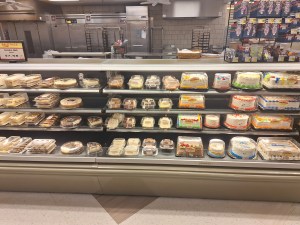
Processed foods became incorporated into home recipes as promoted by magazines. Prepared foods (ready to eat or ready to heat and eat) became entrenched in food prep at home. These and other convenience products “allowed women to hold down a job and prepare meals at home.” Supermarkets delivered foods at lower prices, “efficiency, service, and progress.” Differentiating between grocery stores and supermarkets is a moving target. Many grocery stores of today would have been considered supermarkets in the 1990s. To be considered a supermarket today requires a bakery, a butcher shop, a pharmacy, and multiple departments.

Mass marketing led to a gradual loss of targeting women, but grocery stores are still considered symbolic of “domestic femininity.” Hardware stores became symbols of “domestic masculinity.” Trading stamps and games led to increased sales volumes but did not lead to reduced prices. These were the forerunners to cash points or the fuel points I accumulate each Monday at my local supermarket. Were these gimmicks pleasing women or merely an attempt to fool them? The author of the book suggests that the evolution of the supermarket promoted independence for women at first, but it may have become a “symbol of disrespect and subjugation!”

One of the benefits of aging is that history can refresh one’s memory bank. Much of the history of supermarkets intersects with the story of my life. I remember driving to the stand-alone, near-by butcher shop on my tricycle when I was about 5 or 6 to buy 15 cents worth of pork liver. I have shopped for groceries at primitive country stores, roadside stands, neighborhood stores, small chain grocery stores, and bare-bones supermarkets with exposed beams. You might even see me in a Whole Foods supermarket searching for a specialty item. My family saved, pasted, and redeemed S&H Green Stamps for family items. I currently shop at any of three local supermarkets, each of which offer a unique shopping experience.
Take home lessons. Supermarkets dominate the American foodscape. They have overtaken most country stores, neighborhood grocers, corner stores, independent butcher shops, and cooperatives. Their secret? Lower prices and a much wider selection of foods. Supermarkets are designed to provide a one-stop shopping experience and are tied to efficient supply chains. Do they represent a sterile environment that reeks of mass merchandising and marketing. Yes, particularly the bigger ones. Do they represent an overwhelming sense of too many choices and too big a landscape to cover in too short a period of time? Definitively! But would we miss our local supermarket if it went out of business? I would! What would happen to us if there were no supermarkets within a mile in urban settings or within ten miles in rural areas. We could be in danger of becoming dependent on fast food, dollar stores, and gas stations just to put food on our kitchen table. We have a term for that! It’s called a food desert! Just saying.
Before we disrespect our supermarkets, think back to days before they evolved. Were the good old days better than today? If so, why does this format dominate the current system? If we reimagine the supermarket, will the alternative provide a better and less expensive shopping experience, a more sustainable environment, and less food waste without creating more new problems than old ones it solves?
Coming soon: Wholesale markets and the problem with the middleman!


2 thoughts on “How did the supermarket originate? How did it evolve?”