
Anthony Fardet
For decades, the nutri-centered (based on the nutrient content of foods) and reductionist scientific approach has dominated the development of worldwide nutritional recommendations and the development of composition scores to help choosing industrial foods (1). While this approach is useful for building food composition databases, correcting nutritional deficiencies and defining nutritional needs, it is useless for preventing chronic diseases and says almost nothing about the real health food potential (2). Indeed, one can fulfill all one’s nutritional needs while being chronically ill.
I am honored to introduce the work of Dr. Anthony Fardet to my blogsite. I am grateful to Linn Steward for introducing us electronically. Anthony has introduced the concept of the food matrix to the discussion surrounding ultra-processed foods and its role in the development of chronic diseases. There are many points that he makes in today’s post that I disagree with. However, he makes a much stronger case against ultra-processed foods than any other that I have read. His work represents a comprehensive, well thought-through argument that helps us understand why we might want to be more cautious when consuming ultra-processed products. His 3 V’s approach to diet and health described below is also intriguing, and more realistic than the plant-based, whole foods approach described earlier on this site. As one of his ultra-reductionist food scientists he mentions, I agree that we could benefit from more holistic thinking when we approach current issues in food and nutrition. RLS
The need for a complementary holistic approach in food science and nutrition
Food sciences are first and foremost holistic in essence (3). Thus, the act of eating is multidimensional, including health, environment, socio-economic factors, etc.; and chronic diseases are multifactorial (4), implying a holistic prevention.
Notably, the ultra-reductionist paradigm, considering foods exclusively based on the sum of nutrients, has led to massive marketing of ultra-processed foods (5), produced from fractionated/recombined cosmetic agents ± real ingredients (6). However, this approach overlooks the role played by the links between nutrients (interactions) on human health and the role of the food matrix. This means that foods of similar composition but different matrices (e.g., solid versus finely grounded matrices) do not necessarily have the same physiological, metabolic and health effects in humans on the long term, as well demonstrated with starchy foods and glycemic index (2).
If we adopt a holistic perspective on food health potential and protective dietary patterns we can reach new empirico-inductive unifying paradigms (7); notably that a healthy food is not a nutritionally balanced one because it does not exist except breast milk, hence the recommendation “to eat varied foods”; but it is a food with the most preserved matrix, i.e., the less processed one to be both safe, tasty and edible. However, most foods need to be processed in one way or another: therefore, the real issue is not processing, nor industrial foods, but the acceptable degree of processing so as not to put in danger human health, and more generally global health.
Indeed, before the advent of ultra-processing after the Second World War (mainly related to the food matrix deconstruction up to the nutrient level, followed in some cases by enzymatic and chemical modifications), traditional food processes, at both home and industrial levels, were never associated with such a level of chronic disease pandemics. They were thermal, mechanical and fermentative treatments, added or not with culinary ingredients to render foods tastier and safer and to extend shelf life (8).
In the end, based on a holistic approach in food science and nutrition, increased chronic disease prevalence worldwide is first due to the excessive degradation and/or artificialization of the food matrix (primary cause), not food nutrient contents. As secondary effects, consuming ultra-processed foods in excess may lead to less chewing and satiety, excess empty calories, added salt/fat/sugar, xenobiotics, and pesticide residues consumption, loss of the synergy between nutrients (as for antioxidants), and above all binge eating, inappropriate eating contexts, or any disordered eating pattern. This is why food matrices govern the health effects of nutrients which are neutral by essence. Their positive health effects are depending on the quality of the food matrix and their interactions with other nutrients. There are therefore not “bad” and “good” nutrients, but only “good” and “bad” food matrices. Saying it differently: “Matrix governs; nutrients obey”.
Let’s take the example of dried fruits and sweetened sodas. Dried fruits contain around 4-5 more sugars /100 g than soda, yet sodas have been consistently associated with increased prevalence of type 2 diabetes (9) and obesity (10) while not for dried fruits (11; 12). Why? In dried fruits sugars are natural and enclosed in a solid food matrix with many associated potentially protective bioactive compounds, leading also to chewing; while sodas are ultra-processed and liquid food matrices with added sugars (i.e., “a-matrix” free sugars). Thus, matrix effect matters for health.
A holistic approach of a protective diet for global health: the 3V’s rule
We have defined what should be considered a healthy food based on a holistic approach. But one consumes complex dietary patterns over the course of a week. Therefore, it appears crucial to define the dimensions that govern the diet-global health relationship. The plant/animal-based food ratio and the food diversity have already been well studied and emphasized, but the emerging dimension of the degree of processing was lacking (3). Indeed, it is not enough to “vegetate” our plate for limiting environmental degradation if it is reached through ultra-processed plant-based foods, both for health (13) and the environment (14). The degree of food processing dimension was the missing link.
By including these three interconnected and generic dimensions together we have developed the holistic and qualitative 3V’s rule (15), meaning that if one dimension were to be missing it would no longer work for global health. We were able to achieve this observation by adopting an empirico-inductive and holistic approach (inductive, because we start from reality to go back to theory, and holistic, for our search for links between the parts of complex systems that are foods and diets).
First, the order of these three dimensions that we are talking about is not insignificant for our food choices (Figure 1).
food choices (Figure 1).
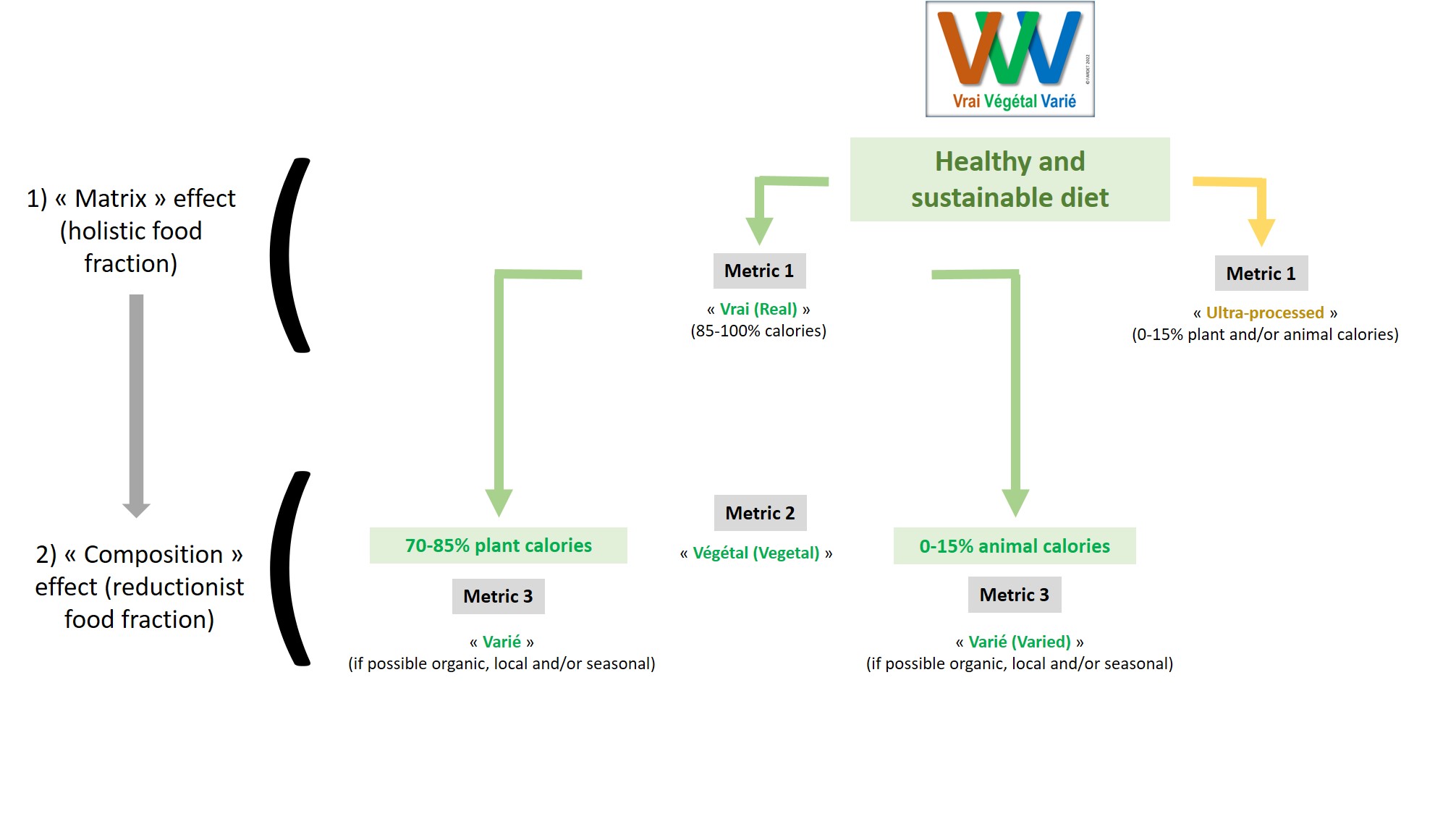
Furthermore, it is worth pointing out that while the “Real” rule addresses the “matrix” effect of foods (their general structure), the “Vegetal” and “Variety” rules concern the “composition” effect at the level of the dietary pattern. Thus, the farmer-breeder produces the “Vegetal” and the “Varied” (and therefore the supply of nutrients and calories to the population) while the processor produces the “Real” … or not. At the end of the chain, the consumer buys food one by one in the store (not directly a diet), and must therefore first consider the “Real” rule (therefore the degree of processing) for his choices. Afterwards, to make up his diet, he chooses his “vegetal/animal products” ratio and the diversity (or even the origin) of his food.
Conversely, if we choose our foods based on the composition only, we can buy many ultra-processed foods that are well rated with composition score, e.g., in France 57% of industrial foods scored A/B with Nutri-score are ultra-processed (16).
In conclusion, eating healthy and sustainably is rather simple provided we adopt a holistic approach. For agro-food industry the main challenge would be therefore to develop less processed foods with the most preserved food matrices so that nutrient be healthy.
Anthony Fardet has been trained as an agro-food engineer (French AgroParisTech high school) and a PhD in Human Nutrition (Aix-Marseille University). As researcher, he has worked for 25 years in public research at the preventive diet-health interface. His main research focus is the link between food processing, matrix and health potential, with a focus on ultra-processing, food scoring and food system sustainability. Based on a holistic approach he has developed several unifying new paradigms in food and nutrition sciences. He has also edited two popularizing books in French.
References
1. Scrinis G (2013) Nutritionism – The Science and Politics of Dietary Advice: Columbia University Press.
2. Fardet A, Rock E (2022) Chronic diseases are first associated with the degradation and artificialization of food matrices rather than with food composition: calorie quality matters more than calorie quantity. Eur J Nutr 62, 2239-2253.
3. Fardet A, Rock E (2014) Toward a new philosophy of preventive nutrition: from a reductionist to a holistic paradigm to improve nutritional recommendations. Advances in Nutrition 5, 430-446.
4. Fardet A, Boirie Y (2013) Associations between diet-related diseases and impaired physiological mechanisms: a holistic approach based on meta-analyses to identify targets for preventive nutrition. Nutr Rev 71, 643-656.
5. Fardet A, Rock E (2022) Exclusive reductionism, chronic diseases and nutritional confusion: degree of processing as a lever for improving public health. Crit Rev Food Sci Nutr 62, 2784–2799.
6. Monteiro CA, Cannon G, Levy RB et al. (2019) Ultra-processed foods: what they are and how to identify them? Public Health Nutr 22, 936-941.
7. Fardet A, Lebredonchel L, Rock E (2023) Empirico-inductive and/or hypothetico-deductive methods in food science and nutrition research: which one to favour for a better global health? Crit Rev Food Sci Nutr 63, 2480-2493.
8. Fardet A (2018) Chapter 3 – Characterization of the degree of food processing in relation with its health potential and effects. Adv Food Nutr Res 85, 79-121.
9. Imamura F, O’Connor L, Ye Z et al. (2016) Consumption of sugar sweetened beverages, artificially sweetened beverages, and fruit juice and incidence of type 2 diabetes: systematic review, meta-analysis, and estimation of population attributable fraction. British Journal of Sports Medicine 50, 496-U484.
10. Ruanpeng D, Thongprayoon C, Cheungpasitpom W et al. (2017) Sugar and artificially sweetened beverages linked to obesity: a systematic review and meta-analysis. Qjm-an International Journal of Medicine 110, 513-520.
11. Keast DR, O’Neil CE, Jones JM (2011) Dried fruit consumption is associated with improved diet quality and reduced obesity in US adults: National Health and Nutrition Examination Survey, 1999-2004. Nutr Res 31, 460-467.
12. Hernandez-Alonso P, Camacho-Barcia L, Bullo M et al. (2017) Nuts and Dried Fruits: An Update of Their Beneficial Effects on Type 2 Diabetes. Nutrients 9.
13. Gehring J, Touvier M, Baudry J et al. (2020) Consumption of Ultra-Processed Foods by Pesco-Vegetarians, Vegetarians, and Vegans: Associations with Duration and Age at Diet Initiation. J Nutr 151, 120-131.
14. Fardet A, Rock E (2020) Ultra-processed foods and food system sustainability: what are the links? Sustainability 12, 6280.
15. Fardet A, Rock E (2020) How to protect both health and food system sustainability? A holistic ‘global health’-based approach via the 3V rule proposal. Public Health Nutr 23, 3028-3044
16. Ebner P, Frank K, Christodoulou A et al. (2022) How are the processing and nutrient dimensions of foods interconnected? An issue of hierarchy based on three different food scores. International Journal of Food Science and Nutrition 76, 770-785.


Here is a long comment.
Nothing much, just a few words for us to test if everything is working in this comment section.
I’m adding a few more words here just in case.
Thank you for helping us help you!
LikeLike
Thank you.
LikeLiked by 1 person
Rob.This sounds like Systems Thinking, as
LikeLike
It is a systems approach to food and nutrition, Stan. If you read my last two posts you will see the influence you had on me to think more holistically.
LikeLike