
The Nutrition Facts Label hit the shelves the same year I went back to school to study nutrition. The year was 1994 and I can still remember holding a package of corn chips in my hand with the newly minted label printed in bold black type and thinking to myself – it’s not going to work.
As it turns out I was right. The original optimism that surrounded the launch of what has now become the familiar Facts label has been shattered by the deteriorating health status of Americans. We’re fatter and sicker than most other populations in the rest of the world.
Linn Steward and I both write about food, but we view it through different prisms. I highly recommend her blog. We write to each other, try to understand each other’s viewpoint. At times we agree. More often we disagree, but we respect each other’s perspective. In a time where disagreement about almost everything is common, we try to understand each other. We hope this dialog will help bring more light than heat. Consider this post a counterpoint to my review last week—RLS
From Label to Table was published in 2023 and it’s the first book I’ve read that has provided me with the starting point to address my initial reaction to the Nutrition Facts Label.
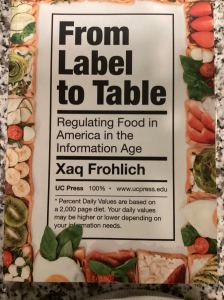
The book charts the history of the Food and Drug Administration from the dawn of the 20th century (1902) to present day. It’s the story of good intentions, knowledgeable scientists, consciousness administrators – everyone who worked to form the FDA as we know it today. Of particular relevance to me are the last two chapters which cover the launch of our iconic Facts label and emergence of lifestyle branding.
By the time I decided to go back to school to study nutrition in the 1990s, I was already an accomplished home cook and a hopeless foodie. I had spent the prior decade exploring my passion for food.
Farm sitting in British Columbia had taught me how to gather freshly laid eggs, milk cows, and make butter. Farm sitting had also taught me about the need to bring in all the summer vegetables when there’s early frost and the devastation caused when a fox attacks the chicken coup at night. Private cooking in a Paris suburb had polished my culinary skills, menu planning, and presentation skills. And after shopping French open-air markets, I knew all about farm to table before the phrase was even envisioned.
College graduates like me who majored in humanities had to start at square one – chemistry, organic chemistry, biochemistry, biology, microbiology, physiology, and statistics. I wasn’t surprised by how much I didn’t know about nutrition because I knew why I was back in school. What surprised me however was how little my fellow dietetics students knew about food. Most didn’t cook. None had set foot on a farm. No one shared my passion for the radiant complexity of our varied foodscape.
I learned from the book that although the word “nutritionism” wasn’t coined for another 10 years after the Facts Lavel mandate, our Nutrition Facts Label was the first official declaration that nutritionism had begun in the early 1990s. Concurrently the word “healthy” started its transition from a general all-purpose word for describing the state of wellbeing to a tightly regulated precise denotation called a nutrient content claim which measured healthy in milligrams of sodium and grams of saturated fat.
That insight makes it easier to understand why my fellow students had no problem dismissing food and focusing on nutrients. The backstory as I learned from the book was that work was being done behind the scenes during the 1980s and the vision for the Facts approach was already under way. Convenience was king. Moms had careers. Nutritients were coming of age.
Now I’m the first person to argue that nutrients are not important. Nutrients are very important. And I’m grateful I had the opportunity to study nutrition. But food is equally important. Food is cultural identify and traditional celebrations and habits and social interactions, none of which can be measured in nutrients but are at least in my opinion just as important.
The decades that followed introduced a new age of lifestyle labeling. Animal Welfare. rBHG Free. Non-GMO. Fair Trade Certified. One of the most notable is USDA Organic.
The same problems exists for me with certifications that exists with the Facts label. I learned from the book about the backstory of the organic movement which lead to the USDA Organic Label. The author walked me through some of the controversies surrounding precise definition because the term itself is holistic. “The push for the USDA to certify organic foods in the 1990s is an interesting example of the tradeoffs in institutionalizing a social movement and mainstreaming an alternative food ideal. It’s was also an example how labeling lifestyles transformed into consumerism.”
I remember vividly shopping a farmers’ market and watching a young woman refuse to buy produce from one of my favorite vendors. The issue was whether or not the produce was certified organic. I watched in amazement as the folks who grew those gorgeous lettuces and freshly picked radishes and iridescent eggplants and all the other beautiful vegetables explained that certification was expensive, that they supported the spirit of organic, and that they were prudent about pesticide use. But as a small farm with limited means, going through the certification process was too costly and time consuming.
The young woman was visibly distrustful and clearly afraid to trust the people in front of her. So like the good consumer she was, off she went in search of the label and a vendor she could trust.
I notice even today that much of the popular journalism written by my fellow dietitians doesn’t tell me what I want to know about food. It’s useful to know that carrots are a source of beta carotene. Or kale is “packed with nutrients”. Sometimes it sounds to me however that my colleagues are marketing supplements instead of encouraging their readers to eat more fruits and vegetables.
The author sums things up nicely in this closing chapter of the book with this statement. “We are starving for knowledge about our food on a stomach full of information.”
From Label to Table is the story of how we got to this point. It should be required reading for every dietitian and for anyone else who cares about food. The Facts are important, the facts aren’t enough when the folks don’t know that food is more than the sum of its nutrient parts.
—
Linn Steward RDN
Gourmet Metrics LLC
Recipe Analyst / Food and Nutrition Consultant

 In Defense of Processed Food
2 thoughts on “What food labels don’t tell us about food by Linn Steward”