
Linn Steward and I have very different perspectives in ultraprocessed, hyperpalatable, and healthy foods. Over the years, we have discussed these differences in emails, on this blog, and even a debate in Food Technology. What we have tried to do is find some common ground on these very divisive topics. Sometimes we have succeeded. Other times we respected each other’s differences of opinions. I turn this post over to her, and I will respond in a later post–RLS.
Sorting out the differences between ultraprocessed, hyperpalatable, and “healthy” is a challenge. Anyone following the current food narrative will already know that these words are used a lot in many different contexts. Given the complexity of the food environment, it’s not easy to sort through and clarify where the words overlap and where they clash. So when Rob suggested I put together a post to sort through the differences using my recipe collection for examples, I jumped at the chance.
But before I get to my recipes, let me tell you why I’m exceptionally qualified for the task.
About a year ago, I took a cold hard look at our current Dietary Guidelines. The guidelines read like a report card on how poorly Americans eat. Our collective score is 59 / 100. Too much salt, sugar, saturated fat; not enough whole grains, fruits, and vegetables. Why do my fellow Americans choose not to eat whole grains, fruits, vegetables?
As a recipe analyst, an avid home cook, and a dietitian, I’m positioned well to explore that issue. So I rolled up my sleeves, set myself up with The Food Processor, my software analysis tool, and started working my way through my recipe collection. The collection consists of the foods I ate growing up in California, the meals I cooked when I lived in France and traveled in Italy, the restaurants we explored in New York City prior to the 2019 COVID lock down. To round the number out to an even 100, I added a couple more from major cooking magazines like Saveur and Epicurious.
Over the last 10 months, I’ve put together an approach using the 4 NOVA food groups, the proposed FDA update to the word “healthy” (limits of sodium, saturated fat, added sugar, portion size), and a qualitative definition of hyperpalatable. When I cook, I use mostly minimally processed ingredients. I season to taste with salt, have a generous hand with olive oil, and use cane sugar for baking.
Since home cooked meals are not usually considered ultraprocessed, Rob and I have decided to put the question of ultraprocessing aside for the moment and focus instead on hyperpalatable and “healthy”. There could be exceptions to this observation and I’ve run the numbers on recipes that did consist of mostly ultraprocessed ingredients, so I know it’s possible. But my recipe collection does not include these exceptions because that’s not the way I cook.
To assess for hyperpalatable, I’ve used a qualitative definition developed by a researcher Tara Fazzino. This definition is based on percent calories from simple sugars, carbohydrates minus simple sugars & fiber, total fat, and sodium as percentage of weight. Nutrients are clustered in three groups: fat / sugar, fat / sodium, carbohydrates / sodium. Using a quantitative metric provides an objective measure as opposed to a subjective opinion.
To assess for “healthy” I’ve used the proposed FDA update for using the word on food product labels – a set of criteria based on food groups, nutrient thresholds, and portion size.
Moving on to the recipes, I’ve selected three as examples of “healthy”, palatable, and hyperpalatable respectively. Then I’ve added a fourth that qualifies as both “healthy” and hyperpalatable.
About 25 of the recipes in my collection qualify as “healthy”. Compliance with a pattern based on chronic disease reduction risk doesn’t always mean the Kiss of Death, but this philosophy of dietary correctness is often incompatible with palatable. The recipes in my collection that fit a “healthy” pattern are most of my vegetable sides, salads, and a summer fruit plate – all limited to a 1/2 cup serving. Problem is I love vegetables so I always enjoy a larger portion.
When choosing an example, I looked for a vegetable that I serve but also fits a 1/2 cup serving size. Steamed artichoke served with yogurt and mayonnaise dressing was a good fit. Ingredients in descending order by weight are: California globe artichoke, dressing (whole milk plain yogurt, commercial mayonnaise). It’s a light, refreshing introduction to any meal. And it’s officially “healthy”.
Roughly 39 out of 100 recipes are neither “healthy” or hyperpalatable. So I’ve developed a category that I call palatable. Examples in this category include roast chicken, baked salmon, omelet, all my soups, a few salads, and three desserts – pears in red wine, chocolate covered walnuts, cantucci (or as we call them here Italian biscotti).
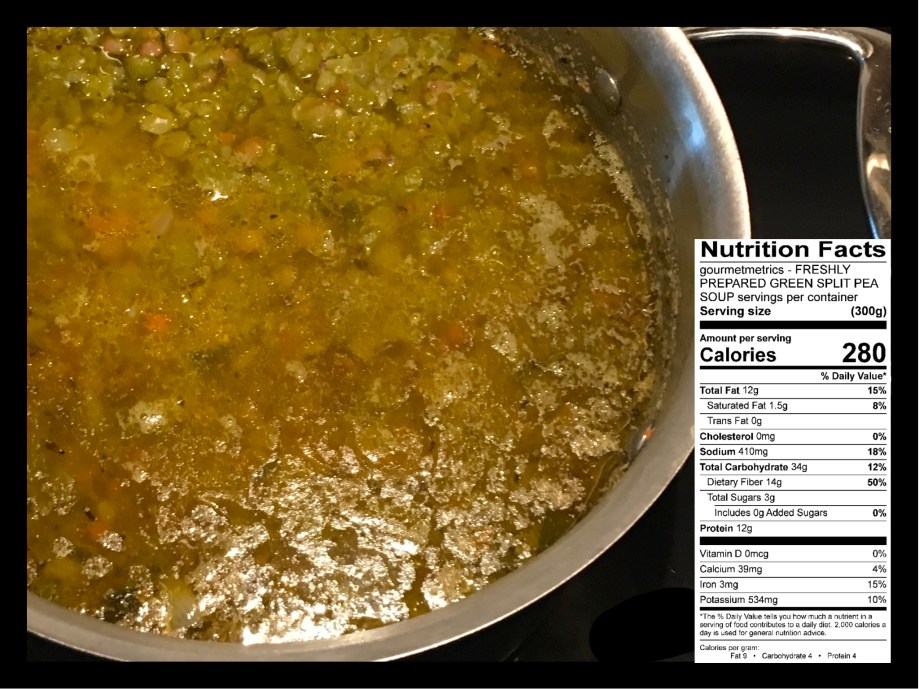
During the winter, I make my own split pea and lentil soups because I find commercial brands too salty. Here’s the ingredient list for my green split pea soup: water, dry split peas, mirepoix (onion, carrot, fennel), olive oil, parsley, salt. Still too much salt but considerably less than the popular commercial brands.
I’ve developed the proportions over time and the amount of salt definitely reflects my personal preferences so it tastes good to me. But a recipe that doesn’t meet each of the thresholds for chronic disease reduction is just as unhealthy as a formulation with significantly more salt.
Another 35 meet the quantitative definition for hyperpalatable. Examples of recipes that qualify include all baked goods, a bowl of plain whole milk yogurt, blueberries, maple syrup, Classic Boston baked beans, Greek watermelon & feta salad, Puerto Rican flan.

As an example, I’ve chosen my Rolled Oat, Walnut, Raisin Cookie. Ingredients listed in descending order by weight: egg, butter, walnuts, whole wheat flour, rolled oats, raisins, sugar, vanilla extract, salt. Both flour and oats are whole grain which means the fibers have not been extracted from their original food matrix. I could reformulate with canola oil instead of butter and dates instead of cane sugar. But I like the taste of the cookies just the way they are so I don’t bother.
The final example is a recipe that qualifies as both “healthy” and hyperpalatable. I carry a handful of dried unsulfured apricots & mixed unsalted roasted nuts when I know I’m going to skip a meal. Doesn’t need refrigeration, tastes really good, and packs about 180 calories which is equivalent to a snack bar. My handful does meet the thresholds form “healthy”; however the dried apricots are just over 50% sugar. It’s the natural sugar always found in fresh fruit, but when the apricots are dried, they lose most of their water content and this concentrates the sugars. So my handful technically meets the criteria for both fat (nuts) and sugar (apricots).
Food and eating have traditionally been a source of pleasure and enjoyment. It’s been my observation that dietary advice works best when that advice is respectful of cultural preferences, traditional patterns, and basic common sense.
Coming soon: Sorting out the differences between ultraprocessed, hyperpalatable, healthy in manufactured foods

 In Defense of Processed Food
3 thoughts on “Sorting out the differences between ultraprocessed, hyperpalatable, healthy in homemade foods by Linn Steward”